Premix production sits at the intersection of nutrition, process control, ingredient management, and regulatory compliance. Anyone planning a new operation needs to consider more than blending capacity; formulation accuracy, hygiene, traceability, worker safety, and certification requirements all shape the facility. Proper selection of feed plant machinery influences both daily production and the consistency of finished products. FAMSUN equipment illustrates one part of this broader approach, with mixer technologies designed for mash-processing applications.
Define The Premix Business Model
Before equipment is specified, the intended product range should be clearly established. Vitamin-mineral premixes, trace-mineral blends, enzyme products, and specialty nutritional concentrates vary considerably in density, flowability, dosage, and segregation characteristics.
Production volume also affects the plant concept. Small operations may prioritize flexible batch sizes and straightforward changeovers, whereas larger facilities typically require automated weighing, ingredient conveying, recipe management, and integrated quality records.
Ingredient characteristics deserve equal attention. Fine powders behave differently from coarse carriers, while hygroscopic components absorb moisture and develop flow problems during storage. These differences directly influence hopper geometry, conveying methods, weighing systems, and mixer selection.
Select Mixing Technology Around Formulation Needs
Mixing quality depends on rotor geometry, fill level, ingredient sequence, mixing time, and the physical properties of the formulation. Premix products are especially sensitive because relatively small quantities of active ingredients must be distributed through much larger carrier volumes.
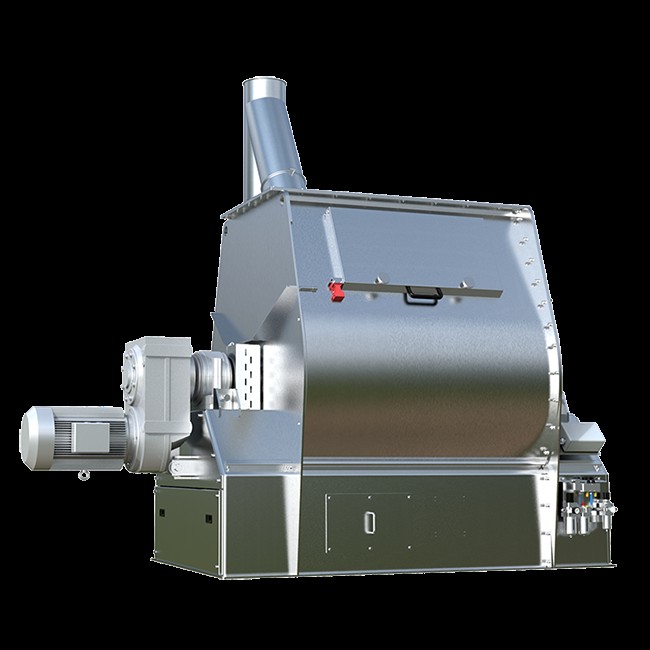
FAMSUN’s SJHS Double-Paddle High-Efficiency Mixers are designed for mash mixing within feed-processing applications. The equipment uses double-paddle mixing technology, while shaft-end sealing focuses on leakage control. Its discharge gate incorporates a locking device intended to maintain rigidity and sealing performance during operation.
Choosing a feed machine should begin with formulation requirements rather than nominal capacity alone. Evaluation should cover batch size, target coefficient of variation, liquid-addition requirements, cleaning frequency, ingredient density, and expected production schedule.
Build Accurate Ingredient Dosing Into The Process
Premix production often involves ingredients with dramatically different inclusion rates. Macro-ingredients are weighed in kilograms, while micro-components require much finer dosing resolution. Errors at this stage affect nutritional specifications even if subsequent mixing performs well.
Separate weighing systems are appropriate when ingredient ranges vary widely. Loss-in-weight feeders, precision scales, and controlled micro-dosing systems help match the measurement method to the quantity being added. Calibration routines should also be scheduled according to equipment usage and applicable quality procedures.
Material flow deserves attention after weighing. Poor transfer design creates residue, bridging, or segregation before ingredients reach the mixer. Consequently, feed plant machinery should be assessed as an interconnected system rather than as isolated pieces of equipment.
Plan Hygienic And GMP-Oriented Layouts
Premix plants should separate clean processing zones from receiving, waste handling, maintenance, and other potentially contaminating activities. Personnel routes and material routes should be considered during layout planning so that unnecessary cross-traffic is minimized.
Surface design matters inside processing areas as well. Difficult-to-access corners, exposed ledges, product-retention points, and damaged surfaces complicate sanitation. Equipment access should allow inspection and routine maintenance without requiring excessive dismantling.
GMP-oriented design also depends on documentation. Cleaning procedures, maintenance schedules, calibration records, ingredient specifications, batch records, and deviation handling should correspond with the actual plant workflow. A feed machine that is easy to inspect and maintain supports these procedures more practically than equipment with inaccessible process zones.
Understand GMP+ And Regulatory Requirements
Certification should be considered during plant planning rather than after construction. GMP+ requirements and local feed regulations affect supplier approval, hazard analysis, traceability, sampling, storage, labeling, and quality management.
Premix producers should establish procedures for incoming-material inspection. Supplier documentation includes specifications, certificates of analysis, allergen information, contamination controls, and storage requirements. Risk-based sampling is then incorporated into the quality system.
Traceability is another critical element. Each batch should be connected to relevant raw materials, production records, operators, processing dates, and finished-product destinations. Such records provide the foundation for investigation if a specification deviation or contamination concern emerges.
Control Cross-Contamination And Product Changeovers
Premix facilities may handle ingredients that require different control measures. Certain minerals, additives, medicated materials, or allergenic substances create carryover concerns when multiple formulations share production equipment.
Production sequencing can reduce unnecessary cleaning frequency while still respecting product-specific controls. Cleaning validation should identify critical areas such as mixer interiors, discharge gates, transfer pipes, hoppers, and weighing components.
The SJHS mixer is particularly relevant to this discussion because its shaft-end sealing technology is designed around leakage prevention, while its discharge gate uses a locking structure for sealing performance. These construction details become meaningful when hygiene, residue control, and maintenance requirements are included in feed plant machinery evaluation.
Conclusion
Launching a premix operation requires coordination between commercial objectives, formulation science, equipment engineering, hygiene, and regulatory management. Mixing capacity does not determine whether a plant can support reliable production; dosing accuracy, material flow, sanitation access, traceability, and certification procedures must fit together as one operating system.
Selecting suitable feed plant machinery starts with understanding the products and ingredients that the facility will handle. From precision dosing and mixer configuration to zoning and documentation, each decision affects production consistency and compliance workload. FAMSUN’s mixing technologies provide one example of how equipment details, such as sealing and discharge design, relate to broader GMP+ and premix-production requirements.